$\renewcommand{\Re}{\operatorname{Re}}$
$\renewcommand{\Im}{\operatorname{Im}}$
$\newcommand{\erf}{\operatorname{erf}}$
$\newcommand{\dag}{\dagger}$
$\newcommand{\const}{\mathrm{const}}$
$\newcommand{\arcsinh}{\operatorname{arcsinh}}$
#[Chapter 4. Separation of variables and Fourier Series](id:chapter-4)
In this Chapter we consider simplest separation of variables problems, arising simplest eigenvalue problems and corresponding Fourier series.
##[4.1. Separation of variables (the first blood)](id:sect-4.1)
-----------------------------------------
> 1. [Separation of variables](#sect-4.1.1)
> 2. [Eigenvalue problem](#sect-4.1.2)
> 2. [Simple solutions](#sect-4.1.3)
> 3. [General solutions](#sect-4.1.4)
Consider IBVP for 1D-wave equation on $(0,l)$:
\begin{align}
& u\_{tt}-c^2 u\_{xx}=0,&& 0\< x\< l \label{eq-4.1.1}\\\\[3pt]
& u|\_{x=0}=u|\_{x=l}=0, \label{eq-4.1.2}\\\\[5pt]
& u|\_{t=0}=g(x) &&u\_t|\_{t=0}=h(x).\label{eq-4.1.3}
\end{align}
###[Separation of variables](id:sect-4.1.1)
Let us skip temporarily initial conditions (\ref{eq-4.1.3}) and consider only (\ref{eq-4.1.1})--(\ref{eq-4.1.2}) and look for a solution in a special form
\begin{equation}
u(x,t)= X(x) T(t)
\label{eq-4.1.4}
\end{equation}
with unknown functions $X(x)$ on $(0,l)$ and $T(t)$ on $(-\infty,\infty)$.
**[Remark 1.](id:remark-4.1.1)**
We are looking for *non-trivial solution* $u(x,t)$ which means that $u(x,t)$ is not identically $0$.
Therefore neither $X(x)$ nor $T(t)$ could be identically $0$
either.
Plugging (\ref{eq-4.1.4}) into (\ref{eq-4.1.1})--(\ref{eq-4.1.2}) we get
\begin{align\*}
& X(x) T''(t)=c^2 X''(x)T(t), \\\\[3pt]
& X(0)T(t)=X(l)T(t)=0,
\end{align\*}
which after division by $X(x)T(t)$ and $T(t)$ become
\begin{align}
& \frac{ T''(t)}{T(t)}=c^2 \frac{X''(x)}{X(x)}, \label{eq-4.1.5}\\\\[3pt]
& X(0)=X(l)=0. \label{eq-4.1.6}
\end{align}
Recall, neither $X(x)$ nor $T(t)$ are identically $0$.
In (\ref{eq-4.1.5}) the l.h.e. does not depend on $x$ and the r.h.e. does not depend on $t$ and since we have an identity we conclude that
**[Remark 2.](id:remark-4.1.2)**
Both expressions do not depend on $x,t$ and therefore they are constant.
This is a crucial conclusion of the separation of variables method. We rewrite it as two equalities
\begin{equation\*}
\frac{T''(t)}{T(t)}=-c^2\lambda,\qquad \frac{ X''(x)}{X(x)}=-\lambda
\end{equation\*}
which in turn we rewrite as (\ref{eq-4.1.7}) and (\ref{eq-4.1.8}):
\begin{align}
&X'' +\lambda X=0, \label{eq-4.1.7}\\\\[3pt]
& X(0)=X(l)=0, \tag{\ref{eq-4.1.6}}\\\\[5pt]
& T''+ c^2\lambda T=0.\label{eq-4.1.8}
\end{align}
###[Egenvalue problem](id:sect-4.1.2)
Consider BVP (for ODE) (\ref{eq-4.1.7})--(\ref{eq-4.1.6}). We need to find its solution $X(x)$ which is not identically $0$.
**[Definition 1.](id:definition-4.1.1)**
Such solutions are called *eigenfunctions* and corresponding numbers $\lambda$ *eigenvalues* (compare with *eigenvectors* and *eigenvalues*.)
**[Proposition 1.](id:prop-4.1.1)**
(\ref{eq-4.1.7})--(\ref{eq-4.1.6}) has eigenvalues and eigenfunctions
\begin{align}
& \lambda\_n = \frac{\pi^2n^2}{l^2}&& n=1,2,\ldots, \label{eq-4.1.9}\\\\[3pt]
&X\_n(x)=\sin (\frac{\pi n x}{l}). \label{eq-4.1.10}
\end{align}
*Proof.* (\ref{eq-4.1.9}) is a 2-nd order linear ODE with constant coefficients and to solve it one needs to consider *characteristic equation*
\begin{equation}
k^2+\lambda =0 \label{eq-4.1.11}
\end{equation}
and therefore $k\_{1,2}=\pm \sqrt{-\lambda}$ and
$X= Ae^{\sqrt{-\lambda}x} + Be^{-\sqrt{-\lambda}x}$ (provided
$\lambda\ne 0$). Plugging into $X(0)=0$ and $X(l)=0$ we get
\begin{align\*}
&A \qquad +B\qquad = 0,\\\\
&Ae^{\sqrt{-\lambda}l} + B e^{-\sqrt{-\lambda}l}=0
\end{align\*}
and this system has a non-trivial solution $(A,B)\ne 0$ if and only if its determinant is $0$:
\begin{equation\*}
\left| \begin{matrix} 1 & 1\\\\
e^{\sqrt{-\lambda}l} & e^{-\sqrt{-\lambda}l}\end{matrix}\right|=
e^{-\sqrt{-\lambda}l}-e^{\sqrt{-\lambda}l}=0
\iff e^{2\sqrt{-\lambda}l} \iff 2\sqrt{-\lambda}l=2\pi in
\end{equation\*}
with $n=1,2,\ldots$. Here we excluded $n=0$ since $\lambda \ne 0$ and both $n$ and $-n$ lead to the same $\lambda$ and $X$. The last equation is equivalent to (\ref{eq-4.1.9}). Then $k\_{1,2}=\frac{\pi n}{l} i$.
Meanwhlie $B=-A$ anyway and we get $X=2Ai \sin (\frac{\pi n x}{l})$ i.e. (\ref{eq-4.1.10}) as factor does not matter.
So far we have not covered $\lambda=0$. But then $k\_{1,2}=0$ and
$X=A+Bx$ and plugging into (\ref{eq-4.1.6}) we get $A=A+Bl=0 \implies A=B=0$ and $\lambda=0$ is not an eigenvalue.
###[Simple solutions](id:sect-4.1.3)
After eigenvalue problem has been solved we plug $\lambda=\lambda\_n$ into (\ref{eq-4.1.8}):
\begin{equation}
T''+ (\frac{c\pi n}{l})^2 T=0
\label{eq-4.1.12}
\end{equation}
which is also a 2-nd order linear ODE with constant coefficients.
Characteristic equation $k^2+ (\frac{c\pi n}{l})^2=0$ has solutions $k\_{1,2}=\pm \frac{c\pi n}{l}i$ and therefore
\begin{equation}
T\_n(t)=A\_n \cos(\frac{c\pi n}{l}t ) + BA\_n \sin (\frac{c\pi n}{l}t ) \label{eq-4.1.13}
\end{equation}
and finally
\begin{multline}
u\_n(x,t)= \underbrace{\bigl( A\_n \cos(\frac{c\pi n}{l}t )+ B\_n \sin (\frac{c\pi n}{l}t )\bigr)}\_{=T\_n(t)} \cdot
\underbrace{\sin (\frac{\pi n x}{l})}\_{=X\_n(x)}\\\\
n=1,2,\ldots
\label{eq-4.1.14}\qquad\end{multline}
This *simple solution* (\ref{eq-4.1.14}) represents a *standing wave*

which one can decompose into a sum of running waves
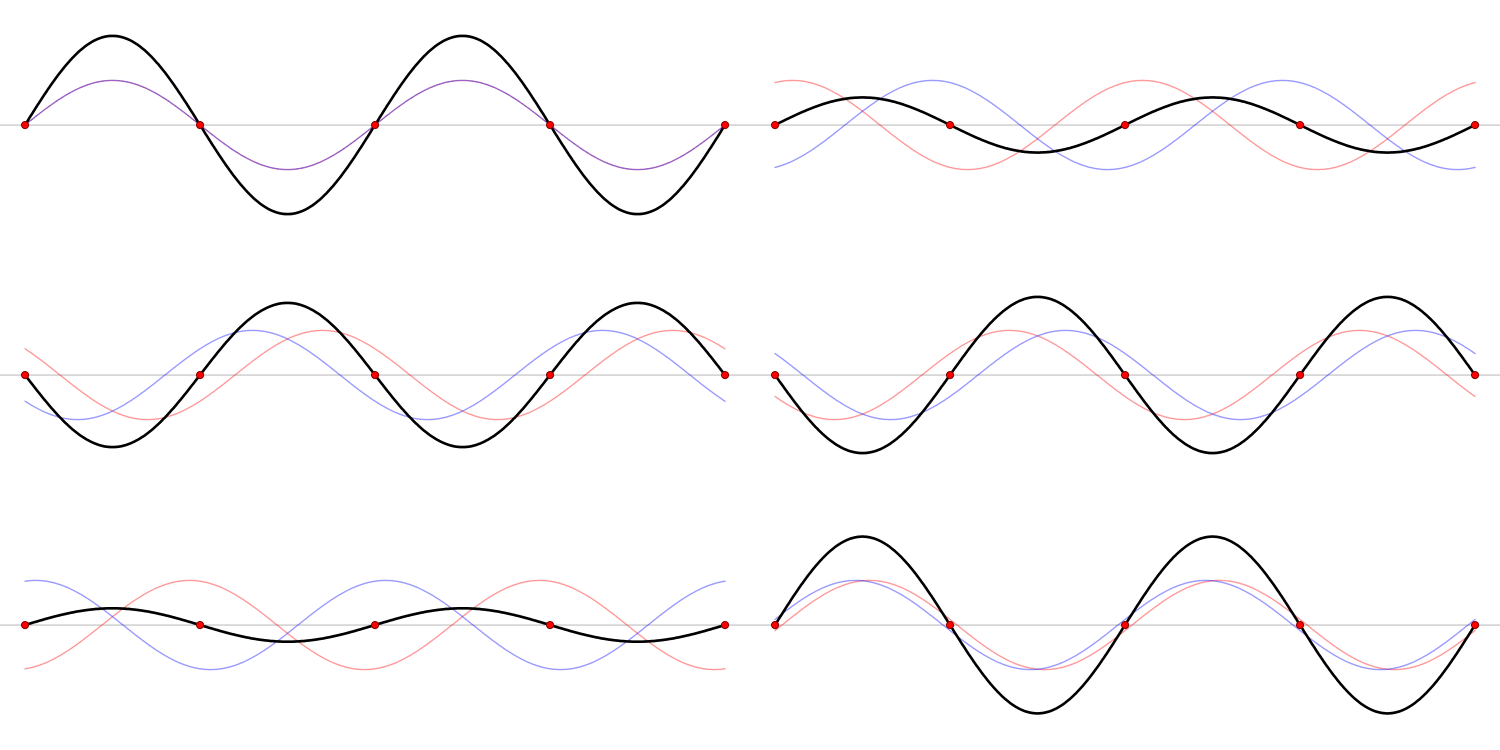
and the general discussion of standing waves could be found in
[wikipedia](http://en.wikipedia.org/wiki/Standing_wave)
###[General solutions](id:sect-4.1.4)
The sum of solutions of
\ref{eq-4.1.1})-(\ref{eq-4.1.2}) is also a solution:
\begin{equation}
u(x,t)= \sum\_{n=1}^\infty \bigl( A\_n \cos(\frac{c\pi nt}{l} )+
B\_n \sin (\frac{c\pi nt}{l} )\bigr) \cdot
\sin (\frac{\pi n x}{l}).
\label{eq-4.1.15}
\end{equation}
We have an important question to answer:
Have we covered all solutions of (\ref{eq-4.1.1})-(\ref{eq-4.1.2})? -- Yes, we
did but we need to justify it.
Plugging (\ref{eq-4.1.15}) into (\ref{eq-4.1.3})1,2 we get respectively
\begin{align}
&\sum\_{n=1}^\infty A\_n \sin (\frac{\pi n x}{l})=g(x),\label{eq-4.1.16}\\\\ &\sum\_{n=1}^\infty \frac{c\pi n}{l} B\_n \sin (\frac{\pi n x}{l} )=h(x). \label{eq-4.1.17}
\end{align}
How to find $A\_n$ and $B\_n$? Do they exist? Are they unique?
What we got are *Fourier series* (actually $\sin$-Fourier series).
And we consider their theory in the several next sections.
---------------
[$\Leftarrow$](../Chapter3/S3.2.html) [$\Uparrow$](../contents.html) [$\Rightarrow$](./S4.2.html)